Showing posts with label 3rd Grade. Show all posts

Tuesday, March 21, 2017

Third Grade Jackson Pollock Instruments

Third Graders studied the artist Jackson Pollock this month in the art room. We looked at some of his "action paintings" and studied his process. Jackson painted with buckets of house paint and he used a paint brush to throw paint onto his canvas, which he placed on the floor. His action painting stirred up the abstract expressionist movement and gathered a lot of attention around his artwork. One of his paintings recently sold for $140 million! We took his idea and then used our painted paper to create instruments. We also looked at complementary colors for our background. Here are our action instruments below!


National Visual Art Standards BY grade 4


1.1 Use a variety of materials and media, for example, crayons, chalk, paint, clay, various kinds of papers, textiles, and yarns, and understand how to use them to produce different visual effects

1.2 Create artwork in a variety of two-dimensional (2D) and three-dimensional

(3D) media 

1.3 Learn and use appropriate vocabulary related to methods, materials, and techniques

1.4 Learn to take care of materials and tools and to use them safely

2.1 For color, explore and experiment with the use of color in dry and wet media
 Identify primary and secondary colors and gradations of black, white and gray in the environment and artwork
Explore how color can convey mood and emotion

2.2 For line, explore the use of line in 2D and 3D works
Identify a wide variety of types of lines in the environment and in artwork

2.3 For texture, explore the use of textures in 2D and 3D works
Identify a wide variety of types of textures, for example, smooth, rough, and bumpy, in the environment and in artwork
Create representations of textures in drawings, paintings, rubbings, or relief

2.4 For shape and form, explore the use of shapes and forms in 2D and 3D works

2.5 For pattern and symmetry, explore the use of patterns and symmetrical shapes in 2D and 3D works
Identify patterns and symmetrical forms and shapes in the environment and artwork.
Explain and demonstrate ways in which patterns and symmetrical shapes

3.2 Create 2D and 3D expressive artwork that explores abstraction

3.3 Create 2D and 3D artwork from memory or imagination to tell a story or embody an idea or fantasy

4.1 Select a work or works created during the year and discuss them with a parent, classmate, or teacher, explaining how the work was made, and why it was chosen for discussion

4.2 Select works for exhibition and work as a group to create a display

4.3 As a class, develop and use criteria for informal classroom discussions about art

5.1 In the course of making and viewing art, learn ways of discussing it, such as by making a list of all of the images seen in an artwork (visual inventory); and identifying kinds of color, line, texture, shapes, and forms in the work 

5.2 Classify artworks into general categories, such as painting, printmaking, collage, sculpture, pottery, textiles, architecture, photography, and film


5.3 Describe similarities and differences in works, and present personal responses to the subject matter, materials, techniques, and use of design elements in artworks 

6.1 When viewing or listening to examples of visual arts, architecture, music, dance, storytelling, and theatre, ask and answer questions such as, “What is the artist trying to say?” “Who made this, and why?” “How does this work make me feel?”

6.2 Investigate uses and meanings of examples of the arts in children’s daily lives, homes, and communities

7.1 Investigate how artists create their work; read about, view films about, or interview artists such as choreographers, dancers, composers, singers, instrumentalists, actors, storytellers, playwrights, illustrators, painters, sculptors, craftspeople, or architects

8.1 Identify characteristic features of the performing and visual arts of native populations and immigrant groups to America, such as 

• styles of North American native cultures of the East Coast, Plains, Southwest, and Northwest;

• styles of folk and fine arts of immigrant groups from European, African, Latin American, Asian, and Middle Eastern countries


Wednesday, February 8, 2017

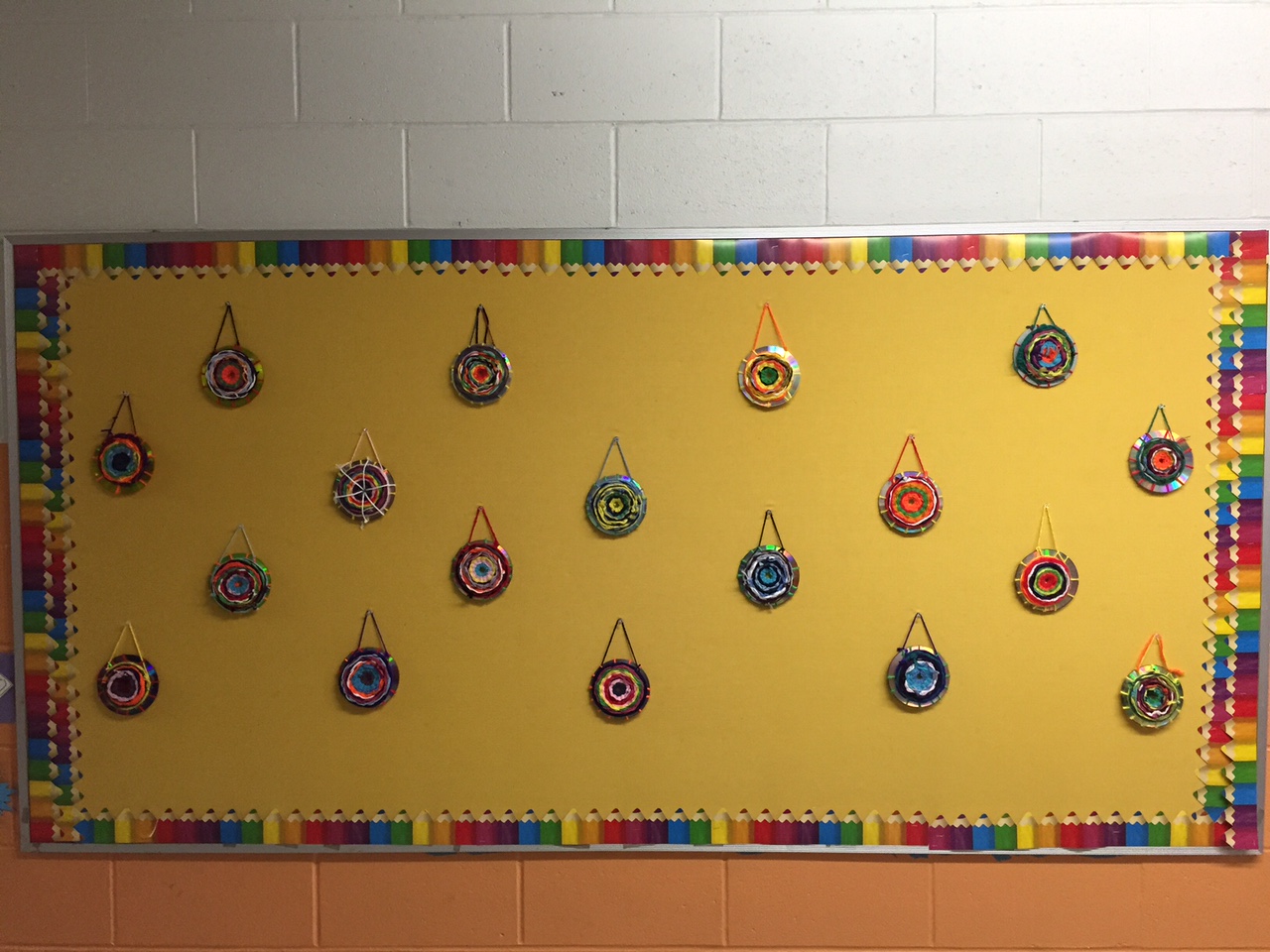
Third Grade CD Weaving

Third Graders worked very hard on this CD weaving project! They first started by creating a warp with their string on the CD. Next they used the weft (the different colored string wrapped around) to weave under and over each string. They created a beautiful radial design that shows off their perseverance and dedication during this project! 


National Visual Art Standards BY grade 4


1.1 Use a variety of materials and media, for example, crayons, chalk, paint, clay, various kinds of papers, textiles, and yarns, and understand how to use them to produce different visual effects


1.2 Create artwork in a variety of two-dimensional (2D) and three-dimensional

(3D) media, for example: 2D – drawing, painting, collage, printmaking, weaving; 3D – plastic (malleable) materials such as clay and paper, wood, or found objects for assemblage and construction 


1.3 Learn and use appropriate vocabulary related to methods, materials, and techniques


1.4 Learn to take care of materials and tools and to use them safely


2.1 For color, explore and experiment with the use of color in dry and wet media

 Identify primary and secondary colors and gradations of black, white and gray in the environment and artwork

Explore how color can convey mood and emotion

For example, students mix light and dark values of colors or predict the results of overlapping and blending primary colors. 


2.2 For line, explore the use of line in 2D and 3D works

Identify a wide variety of types of lines in the environment and in artwork

For example, students take a walk around the school and note jagged, straight, curved, thick, and thin lines. 


2.3 For texture, explore the use of textures in 2D and 3D works

     Identify a wide variety of types of textures, for example, smooth, rough, and bumpy, in the environment and in artwork

Create representations of textures in drawings, paintings, rubbings, or relief


2.4 For shape and form, explore the use of shapes and forms in 2D and 3D works

Identify simple shapes of different sizes, for example, circles, squares, triangles, and forms, for example, spheres, cones, cubes, in the environment and in artwork


2.5 For pattern and symmetry, explore the use of patterns and symmetrical shapes in 2D and 3D works

Identify patterns and symmetrical forms and shapes in the environment and artwork.

Explain and demonstrate ways in which patterns and symmetrical shapes


3.1 Create 2D and 3D artwork from direct observation

For example, students draw a still life of flowers or fruit, action studies of their classmates in sports poses, or sketches of the class pet having a snack or a nap.


3.2 Create 2D and 3D expressive artwork that explores abstraction

For example, a student simplifies an image by making decisions about essential colors, lines, or textures.


3.3 Create 2D and 3D artwork from memory or imagination to tell a story or embody an idea or fantasy

For example, students draw members of a family from memory; illustrate a character in a folktale or play; build a clay model of an ideal place to play; or make images that convey ideas such as friendship.


4.1 Select a work or works created during the year and discuss them with a parent, classmate, or teacher, explaining how the work was made, and why it was chosen for discussion

For example, a first grader chooses a painting and tells how she mixed the colors, and talks about the decisions she made.


4.2 Select works for exhibition and work as a group to create a display


4.3 As a class, develop and use criteria for informal classroom discussions about art


5.1 In the course of making and viewing art, learn ways of discussing it, such as by making a list of all of the images seen in an artwork (visual inventory); and identifying kinds of color, line, texture, shapes, and forms in the work 


5.2 Classify artworks into general categories, such as painting, printmaking, collage, sculpture, pottery, textiles, architecture, photography, and film


5.3 Describe similarities and differences in works, and present personal responses to the subject matter, materials, techniques, and use of design elements in artworks 


5.4 (Grades 3 and 4) Explain strengths and weaknesses in their own work, and share comments constructively and supportively within the group


6.1 When viewing or listening to examples of visual arts, architecture, music, dance, storytelling, and theatre, ask and answer questions such as, “What is the artist trying to say?” “Who made this, and why?” “How does this work make me feel?”


6.2 Investigate uses and meanings of examples of the arts in children’s daily lives, homes, and communities

For example, children learn and teach other children songs in languages other than English; interview parents and community members about dances, songs, images, and stories that are part of their family and cultural heritage.


7.1 Investigate how artists create their work; read about, view films about, or interview artists such as choreographers, dancers, composers, singers, instrumentalists, actors, storytellers, playwrights, illustrators, painters, sculptors, craftspeople, or architects

For example, teachers invite an illustrator of children’s books to school to show how she creates her illustrations.


Wednesday, November 23, 2016

Third Grade James Rizzi Cities

This month, third graders have been learning about the artist James Rizzi. He was known for his bright and colorful cityscapes with faces painted on them. We looked at the different compositions and we noticed a sense of balance in his artwork. After studying his work and inspiration, we the painted our own cityscapes with big personalities. Great job third grade!


Our Artwork at Byam


Tuesday, January 12, 2016

3rd Grade Perspective Landscapes

Third grade took a look at different landscapes that showed perspectivea method of representing the illusion of volume in three-dimensional objects and depth of space on a two- dimensional surface. We  first observed that objects in the background are much smaller than objects in the foreground. Next, we took a look at the vanishing point and horizon line in a landscape. The vanishing point is where two parallel lines appear to meet and the horizon line separates the earth from the sky. Students each drew these on their paper and then created a landscape of their own. Here are just a few results below, great work third graders! 


Visual Arts Standards from this lesson:
  1. 1.1  Use a variety of materials and media, for example, crayons, chalk, paint, clay,
    various kinds of papers, textiles, and yarns, and understand how to use them
    to produce different visual effects

  2. 1.2  Create artwork in a variety of two-dimensional (2D) and three-dimensional
    (3D) media, for example: 2D – drawing, painting, collage, printmaking, weaving; 3D – plastic (malleable) materials such as clay and paper, wood, or found objects for assemblage and construction

  3. 1.3  Learn and use appropriate vocabulary related to methods, materials, and techniques

  4. 1.4  Learn to take care of materials and tools and to use them safely

    2.1  For color, explore and experiment with the use of color in dry and wet media 
    Explore how color can convey mood and emotion

    2.2  For line, explore the use of line in 2D and 3D works
    Identify a wide variety of types of lines in the environment and in artwork 

    2.3  For texture, explore the use of textures in 2D and 3D works
    Identify a wide variety of types of textures, for example, smooth, rough, and bumpy, in the environment and in artwork

    2.4  For shape and form, explore the use of shapes and forms in 2D and 3D works
    Identify simple shapes of different sizes, for example, circles, squares, triangles, and forms, for example, spheres, cones, cubes, in the environment and in artwork

    2.6  For space and composition, explore composition by creating artwork with a center of interest, repetition, and/or balance
    Demonstrate an understanding of foreground, middle ground, and background

    5.3  Describe similarities and differences in works, and present personal responses to the subject matter, materials, techniques, and use of design elements in artworks 

Thursday, December 3, 2015

Third Grade Making Great Waves!

This week, third graders learned about the Japanese artist named Hokusai. We learned that...

Katsuhika Hokusai was born in 1760 in Tokyo and died in 1849
- He started as an apprentice to a printmaker when he was young but was thrown out of the workshop because instead of following the printmaker’s directions, he liked to experiment with prints on his own and try new techniques
- In his lifetime, Hokusai completed over 30,000 works of art.
- Hokusai never cleaned his studio, when the place became too dirty to work, he would move instead of clean up!
- Hokusai often painted in front of an audience and even painted hanging upside down or with the brush between his toes or his mouth!


After talking about Hokusai and his most famous print, The Great Wave, we made our own interpretation using paint and oil pastel. These came out beautiful, nice job Third Graders!


Tuesday, April 7, 2015

3rd Grade Impressionist Landscapes

Third Graders learned about Claude Monet and his seascapes in Antibes, France. Then, we painted our own seascapes using tempera paint and pastel on top to add more texture. We talked about the way Impressionist painters used their brushes to create short brush strokes. Here are some results below!