- Visual Arts Standards in this lesson
- 1.1 Use a variety of materials and media to produce different visual effects
- 1.2 Create artwork in a variety of two-dimensional (2D) and three-dimensional
(3D) media, for example: 2D – drawing, painting, collage, printmaking, weaving; 3D – plastic (malleable) materials such as clay and paper, wood, or found objects for assemblage and construction - 1.3 Learn and use appropriate vocabulary related to methods, materials, and techniques
- 1.4 Learn to take care of materials and tools and to use them safely
2.3 For texture, explore the use of textures in 2D and 3D works. Identify a wide variety of types of textures, for example, smooth, rough, and bumpy, in the environment and in artwork
3.1 Create 2D and 3D artwork from direct observation
5.3 Describe similarities and differences in works, and present personal responses to the subject matter, materials, techniques, and use of design elements in artworks
Showing posts with label 4th Grade. Show all posts
Friday, May 5, 2017
4th Grade Clay Hands
This month in the art room, fourth graders at Byam created beautiful clay textured hands. We explored different line variations and learned how to show low relief and high relief on the clay. After using rolling pins to create a slab of clay, each student traced their own hand and curved it in the shape of a bowl. Then we added designs and color with different glazes. Great work fourth graders!
Tuesday, March 21, 2017
Native American Coiled Baskets
Fourth grade just finished up their Native American inspired coiled baskets. These were made with coiled paper and colored yarn. We studied how Native Americans created baskets for food, water, and everyday items and created our own version. Check out the results below!
National
Visual Art Standards BY grade 4
1.1
Use a variety of materials and media, for example, crayons, chalk,
paint, clay, various kinds of papers, textiles, and yarns, and understand
how to use them to produce different visual effects
1.2
Create artwork in a variety of two-dimensional (2D) and three-dimensional
(3D)
media, for
example: 2D – drawing, painting, collage, printmaking, weaving; 3D – plastic
(malleable) materials such as clay and paper, wood, or found objects for assemblage
and construction
1.3
Learn and use appropriate vocabulary related to methods, materials, and
techniques
1.4
Learn to take care of materials and tools and to use them safely
2.1
For color, explore and experiment with the use of color in dry and wet
media
Identify
primary and secondary colors and gradations of black,
white and gray in the environment and artwork
Explore
how color can convey mood and emotion
For
example, students mix light and dark values of colors or predict the results of
overlapping and blending primary colors.
2.2
For line, explore the use of line in 2D and 3D works
Identify
a wide variety of types of lines in the environment and in artwork
For
example, students take a walk around the school and note jagged, straight,
curved, thick, and thin lines.
2.3
For texture, explore the use of textures in 2D and 3D works
Identify a wide variety of types of textures, for example, smooth, rough,
and bumpy, in the environment and in artwork
Create
representations of textures in drawings, paintings, rubbings, or relief
2.4
For shape and form, explore the use of shapes and forms in 2D and 3D
works
Identify
simple shapes of different sizes, for example, circles, squares, triangles, and
forms, for example, spheres, cones, cubes, in the environment and in
artwork
2.5
For pattern and symmetry, explore the use of patterns and symmetrical
shapes in 2D and 3D works
Identify
patterns and symmetrical forms and shapes in the environment and artwork.
Explain
and demonstrate ways in which patterns and symmetrical shapes
3.1
Create 2D and 3D artwork from direct observation
For
example, students draw a still life of flowers or fruit, action studies of
their classmates in sports poses, or sketches of the class pet having a snack
or a nap.
3.2
Create 2D and 3D expressive artwork that explores abstraction
For
example, a student simplifies an image by making decisions about essential
colors, lines, or textures.
3.3
Create 2D and 3D artwork from memory or imagination to tell a story or embody
an idea or fantasy
For
example, students draw members of a family from memory; illustrate a character
in a folktale or play; build a clay model of an ideal place to play; or make
images that convey ideas such as friendship.
4.1
Select a work or works created during the year and discuss them with a parent,
classmate, or teacher, explaining how the work was made, and why it was chosen
for discussion
For
example, a first grader chooses a painting and tells how she mixed the colors,
and talks about the decisions she made.
4.2
Select works for exhibition and work as a group to create a display
4.3
As a class, develop and use criteria for informal classroom discussions about
art
5.1
In the course of making and viewing art, learn ways of discussing it, such as
by making a list of all of the images seen in an artwork (visual inventory);
and identifying kinds of color, line, texture, shapes, and forms in the
work
5.2
Classify artworks into general categories, such as painting, printmaking,
collage, sculpture, pottery, textiles, architecture, photography, and film
5.3
Describe similarities and differences in works, and present personal responses
to the subject matter, materials, techniques, and use of design elements in
artworks
5.4
(Grades 3 and 4) Explain strengths and weaknesses in their own work, and share
comments constructively and supportively within the group
6.1
When viewing or listening to examples of visual arts, architecture, music,
dance, storytelling, and theatre, ask and answer questions such as, “What is
the artist trying to say?” “Who made this, and why?” “How does this work make
me feel?”
6.2
Investigate uses and meanings of examples of the arts in children’s daily
lives, homes, and communities
For
example, children learn and teach other children songs in languages other than
English; interview parents and community members about dances, songs, images,
and stories that are part of their family and cultural heritage.
7.1
Investigate how artists create their work; read about, view films about, or
interview artists such as choreographers, dancers, composers, singers,
instrumentalists, actors, storytellers, playwrights, illustrators, painters,
sculptors, craftspeople, or architects
For
example, teachers invite an illustrator of children’s books to school to show
how she creates her illustrations.
8.1
Identify characteristic features of the performing and visual arts of native
populations and immigrant groups to America, such as
•
styles of North American native cultures of the East Coast, Plains, Southwest,
and Northwest;
•
styles of folk and fine arts of immigrant groups from European, African, Latin
American, Asian, and Middle Eastern countries
Wednesday, November 30, 2016
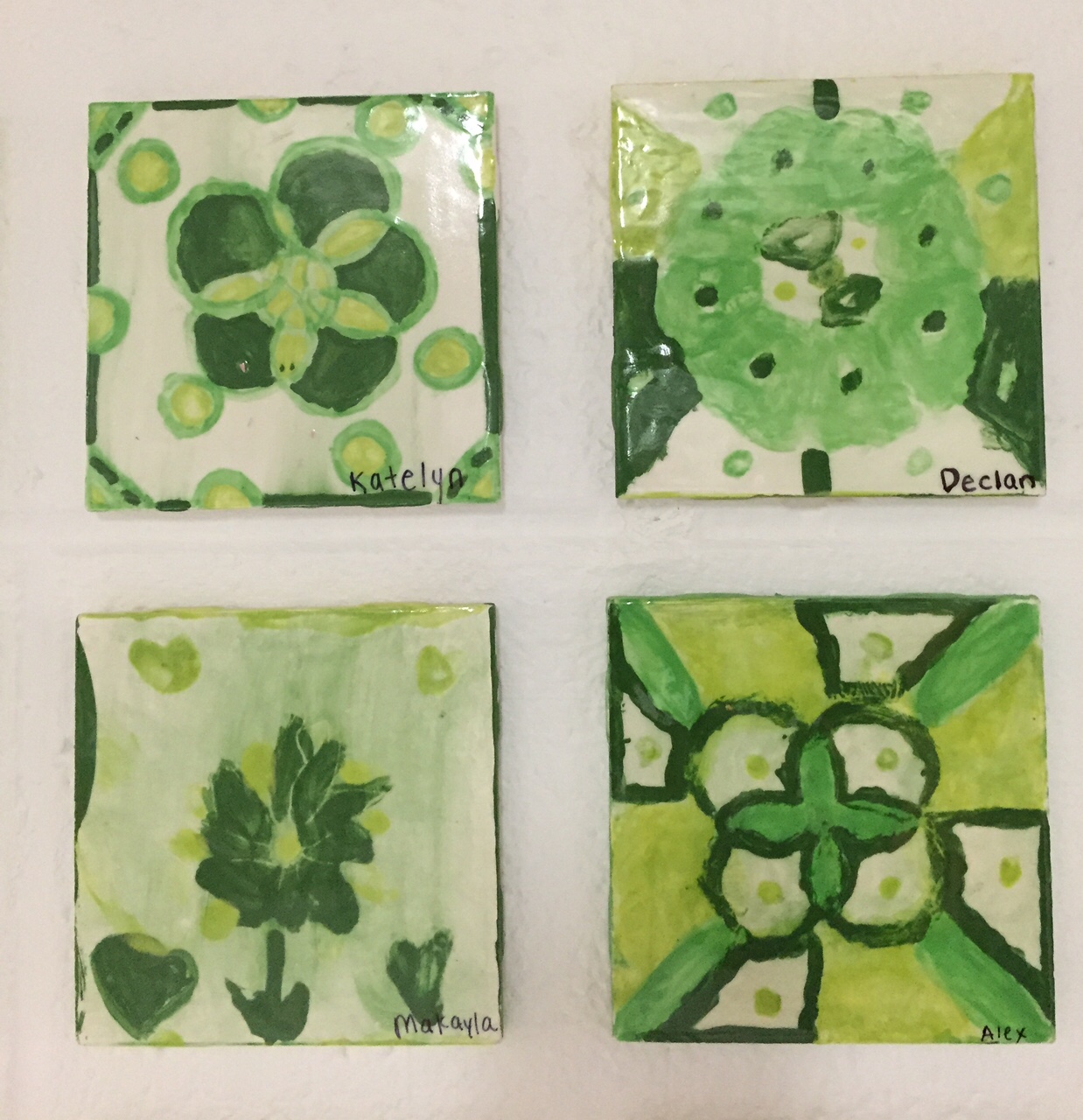
Fourth Grade Tile Mosaic
One of our visual arts standards this term for fourth grade is to "Explore composition by creating an artwork with a center of interest, repetition, and/or balance." I wanted students to create a tile that represented this standard. We first started by looking at pieces of art in the classroom that showed a center of interest, repetition, and balance. We talked about circles, squares, and geometric shapes that could help us get started with our design.
Students started this project by drawing a design in their sketchbooks, and when they were happy with their drawing, they started the final on their ceramic tile. Next, we talked about analogous colors, or colors that are next to each other on the color wheel. Each table was given a color paint and then two colors that were analogous to that color. For example, the yellow table used a yellow-green and a yellow-orange along with the bright yellow I gave them first. Once they were all finished painting, students glazed them and I placed them in the kiln. After taking them out and letting them cool off, I used a tile adhesive to place them on the wall in the color wheel order. These came out beautiful, and will be on the wall at Byam for many years to come. Amazing work fourth graders!
Friday, February 26, 2016
4th Grade Boston Landscapes
This week in the art room, 4th graders looked at the Boston Skyline. We talked about the silhouette of the buildings and the pleasing composition as well. Students first drew with pencil and then outlined with vine charcoal. They had a great time despite some messy hands! It was nice to see the variations and the different ways students manipulated the materials. Great work!
Tuesday, January 5, 2016
4th Grade Mosaic Tile Mural
This year at Byam, I wanted the fourth grade students to leave a ceramic tile as a part of a mural in the front of the school. For this project, fourth grade students created their own 6" x 6" tile that represented their individual connection to Byam School and PRIDE. Each tile is unique and highlights the different talents and qualities of our fourth grade students. This project took about one month for students to brainstorm ideas, sketch their designs, and finally paint on the tile. Once the tiles were painted with a ceramic glaze, they were fired in a kiln and hung up on the wall. These students showed many of the core values of PRIDE while creating this project, excellent work fourth graders!
Tuesday, December 15, 2015
Fourth Grade Self-Portraits
This month, fourth grade students worked on creating self-portraits. They focused on drawing realistic features, creating patterns for their clothing and hair, showing symmetry or asymmetry, and creating visual texture for the background. These came out fabulous and look just like the students! Great job 4th graders, you showed perseverance and dedication when working on this project! Listed below are the visual arts standards we focused on for this lesson.
- Visual Arts Standards in this lesson
-
1.1 Use a variety of materials and media to produce different visual effects
-
1.2 Create artwork in a variety of two-dimensional (2D) and three-dimensional
(3D) media, for example: 2D – drawing, painting, collage, printmaking, weaving; 3D – plastic (malleable) materials such as clay and paper, wood, or found objects for assemblage and construction
-
1.3 Learn and use appropriate vocabulary related to methods, materials, and
techniques
-
1.4 Learn to take care of materials and tools and to use them safely
2.3 For texture, explore the use of textures in 2D and 3D works. Identify a wide variety of types of textures, for example, smooth, rough, and bumpy, in the environment and in artwork
3.1 Create 2D and 3D artwork from direct observation
5.3 Describe similarities and differences in works, and present personal responses to the subject matter, materials, techniques, and use of design elements in artworks
-
1.1 Use a variety of materials and media to produce different visual effects
Thursday, November 19, 2015
4th Grade Wayne Thiebaud Donuts
This month, 4th graders learned about Wayne Thiebaud and his paintings of donuts, ice cream cones, cakes and more. We talked about how to make the donuts look realistic and how to create the illusion of frosting with paint and puffy paint for sprinkles. I also showed students a video on how donuts are made which they loved!
Here are some of Wayne Thiebaud's paintings and below is the 4th grade artwork!
Subscribe to:
Posts (Atom)